Thursday, October 25, 2012

Blog #20 The North Wind and the Sun


Aesop’s Fables: The North Wind and the Sun

Newly Illustrated by Jerry Pinkney
SeaStar Books
2000
77 pages

Traditional Literature

          This newly illustrated collection of Aesop’s Fables includes all of the traditional stories with highly detailed illustrations by Jerry Pinkney. In this particular story, The North Wind and the Sun, the North Wind argues with the Sun that he is stronger than any and everything. The Sun disagrees and challenges him. He says that he is stronger than the North Wind because he can make a traveler take off his coat and hat but bets the North Wind that he cannot. In the end, the Sun is able to warm the traveler and make him remove his hat and coat, but the North Wind only made the traveler cling tighter to them for warmth. 
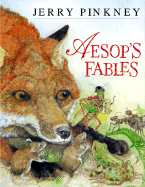

          Jerry Pinkney uses pencil, colored pencil, and water colors to as his medium for his illustrations in this collection. The incredibly detailed layering of watercolor allows for depth and varied saturation of color that creates a realistic tone to the illustrations. These illustrations have a somewhat Van Gogh style to them in regards to the brush strokes and use of color. The style of this book is very formal and mirrors the traditional aspect of Aesop’s Fables

          This would be a great asset to a classroom. To familiarize students with the everyday lessons described in the fables, a teacher could take five minutes at the end of the day to read one short (usually one-paged) fable a day. Because these are so short, the teacher could read one of these to students while they are reading other books in the class and have them make text-to-text connections between the two. This activity would be most appropriate for middle to upper elementary students while the daily character education read aloud would be best suited for younger elementary students. This particular story could be told to students to demonstrate the effectiveness of asking politely for something they want instead of demanding it. 

Below is a video of The North Wind and the Sun: 


Blog #19 The Three Billy Goats Gruff


Yummy: The Three Billy Goats Gruff

Newly Illustrated by Lucy Cousins
Candlewick Press
2009
pages 23-31

Traditional Literature

I chose this book because as I flipped through the pages I like the illustrator’s interpretative style of the traditional literature she was depicting. This particular story is one of eight in the collection of traditional stories illustrated by Lucy Cousins. In this story, three goats are crossing a bridged that is guarded by a troll. When the first goat crosses, the troll says he is going to eat him. The little goat says to wait and that there is a bigger goat than him about to cross the bridge. The medium goat says the same thing when he crosses the bridge. When the largest goat crosses the bride, he stands up to the troll and wins.


          The illustrations in this book are rendered in gouache. The outlines of the characters are thick and black and the colors are mainly blocked and one dimensional. This gives a child-like quality to the illustrations. There is a considerable amount of negative space used throughout. In using the negative space, the illustrator is able to draw attention to the focus of the tales the illustrations are depicting. The style of this book is very informal because some words seem to have been painted across the page and interact with the illustrations.


          As traditional literature usually is, this would be great to use for a character education lesson, in particular on bullying. This story shows that standing up to bullying is the right thing to do and allows for everyone to enjoy themselves freely. I think an excellent way to incorporate this book in the classroom would be to have students illustrate a copy of the tale. Because the style of illustration used in this book is simplistic, it would not intimidate students.

To visit the website for Lucy Cousins most popular book series, the Maisy books, click on her name.  

Blog #18 The Little Red Hen


The Little Red Hen

Newly Illustrated by Jerry Pinkney
Dial Books
2006
29 pages

Traditional Literature

          I chose this book because I love Jerry Pinkney’s illustrations. This is the classic tale of The Little Red Hen. The red hen finds some wheat seeds. She asks her barnyard friends help her plant the seeds, but no one will help her. She then asks them to help her tend the seeds, harvest the wheat, carry the wheat to the mill, and bake the ingredients to make the bread. No one would help her. When finally it came time to eat the fruits of her hard work, everyone wanted a piece of the pie. The red hen told the others that because they did not help her with anything else they could not eat her bread with her.


          Jerry Pinkney’s illustration style is unmistakably detailed. He uses graphite, ink, and watercolor on paper. This mixture of medium allows him to create detailed hashing with layered saturations of color. The entire book is done using double paged spreads. The style of the book is informal because the words are interspersed throughout the pictures but are in structured stanzas and the same font throughout. The illustrations of this book are so detailed the reader feels as though he/she is walking through the barnyard with the red hen. 


          This book would be a great tool for character education when teaching students about doing their part and working as a group. Because this is a universal social skill that all students need to learn, this could be read to older students before group projects to remind students that they must all pull their own weight in the group. For younger students, this book would also be great to use with colors. In this particular book, each character’s name is printed in the color that describes that animal. For second grade students, this book could be used to introduce sequencing.

To visit Jerry Pinkney's website, click on his name.   

Blog #17 Bear Snores On


Bear Snores On 

Written by Karma Wilson
Illustrated by Jane Chapman
McElderry Books
2002
30 pages

Fantasy

            I chose this book because the title and cover art caught my attention; I thought maybe something might happen with the crowd of animals that might keep bear from snoring on. In this story, there is a great storm. Starting with a mouse, animals begin to come to the bear’s lair to escape the blizzard outside. Each time an animal comes, they bring food to add to the party. The animals make stew and add to much pepper, and accidentally wake up the bear! To find out what happens to the animals after the bear wakes up you have to read the book!


            The illustrations were rendered in acrylic. This medium allows for a layering of colors and textures throughout the book. The book alternates from single page spreads with large vignettes on the opposite page to balance the print to double page spreads to display the entire scene of the story. The single page spreads with opposing vignettes are used when new characters are introduced in the story, and the double page spreads are used to display the bear sleeping as the animal gather around him. The glowing reds, yellows, and oranges reflect the warm and cozy feeling of the bear’s den. This stands in contrast with the cold blues and whites of the outside scene depicting the blizzard. 


            This is an excellent book for younger ages when introducing poetry and poetry language. This book includes onomatopoeias, line refrain, end rhyme, and alliteration to name a few. Teachers could use this book to introduce a poetry lesson, have students complete sentence stems to write another animal that might join the party and what that animal might bring, then have them write a sentence about that animal using either alliteration or an onomatopoeia. This could also be used as a counting book. Teachers could use this book to have kindergarteners count the number of animals in the cave at certain times in the story.

To visit Karma Wilson's website, click on her name. 

Blog #16 Down to the Sea with Mr. Magee


Down to the Sea with Mr. Magee

Written and Illustrated by Chris Van Dusen
Chronicle Books
2006
28 pages

Fantasy

      I chose this particular book because the cover art lets the reader know that inside is an adventure. In this book, Mr. Magee takes his dog on a boat ride, but on this day it’s not just an ordinary boat ride. Mr. Magee and his dog Dee come across a pod of whales. While they were unaware, a whale calf swam under their boat. Before they knew it, they were stuck in a tree sixty feet in the air! They waited and waited until it was almost dark, but you’ll have to read the book to find out if and how they made it out of the tree!


      The illustrations in this book are depicted using gouache. The dense consistency of this particular medium adds an unmistakable vibrant saturation to the colors. The style could almost be computer generated because of the style of shading and highlighting used. In the beginning of the book, the perspective and lines are horizontal and smooth reflecting the sense of calm. Toward the middle when the action picks up, the perspective changes and the lines become more vertical reflecting the energy and action during this part of the story. Throughout the book, a double page spread is used to fully display the visual of the story. Also notable is the use of proportion. For the most part, Mr. Magee and Dee are in relatively small proportion compared to their surroundings. This illustrates the vastness of the ocean and how one might feel small in comparison while sailing out to sea.  


      This book has an excellent rhyme scheme and would be great for using during a poetry lesson for third or fourth grade students. For younger students, this book could be used during a math lesson. The teacher could stop reading the book before the ending occurs and ask the students to predict how many whales they think it will take to get Mr. Magee and Dee out of the tree. They could draw a picture of this to demonstrate their understanding of counting using whales. 

To visit Chris Van Dusen's website, click on his name.