Wednesday, October 24, 2012

Blog #13 My Favorite Bear


My Favorite Bear

Written and Illustrated by Andrea Gabriel
Charlesbridge
2004
27 pages

Poetry

       I chose this book because of the detailed close-up illustration of the bear on the cover. This story is about a mother bear telling her baby cub about the other bears in the world. She tells him about several kinds of bears, what different bears like to eat, and what they look like. She finishes the story by telling the baby bear that while there are many bears in the world he is her favorite. 


       The illustrations in this book look to be either oil pastels or crayons. The hash marks created by the different strokes of the crayons give a sense of depth and dimension to the illustrations. Each page is a full illustration with one line of the book on each page or every other page. The main focus of the book is the illustration of the various types of bears. At the end of the book there is a cataloged index of each type of bear depicted in the book with a picture and description of that type of bear. The double-paged spread of most of the illustrations allow for considerable detail to be put into the bears’ features. Although the style of art is not abstract or surreal, it is not overly-realistic to where the reader cannot tell whether they are looking at a painting or a picture.  


       This book is most appropriate for lower elementary grades, mainly kindergarten or first grade. The most evident use of this book would be as an introduction into the different types of bears and how they interact with their environment. An interactive method teachers may use with this book might be to have students draw a picture of a type of bear and write a sentence about that type of bear. For older grades, teachers could have students use this book as a model and have them write their own book about different types of a species of an animal. The book would include at least three types of the species with a cataloged index in the back of the book. Teachers could also have older students do a group project on the different types of bears that would include their habitat, diet, and appearance.

This book was named on the Bank Street College of Education's Best Children's Books of the Year.

To view more illustrations and artwork by Andrea Gabriel, click her name .

Blog #12 The Blue Ribbon Day


The Blue Ribbon Day

Written by Katie Couric
Illustrated by Marjorie Priceman
Doubleday
2004
26 pages

Poetry

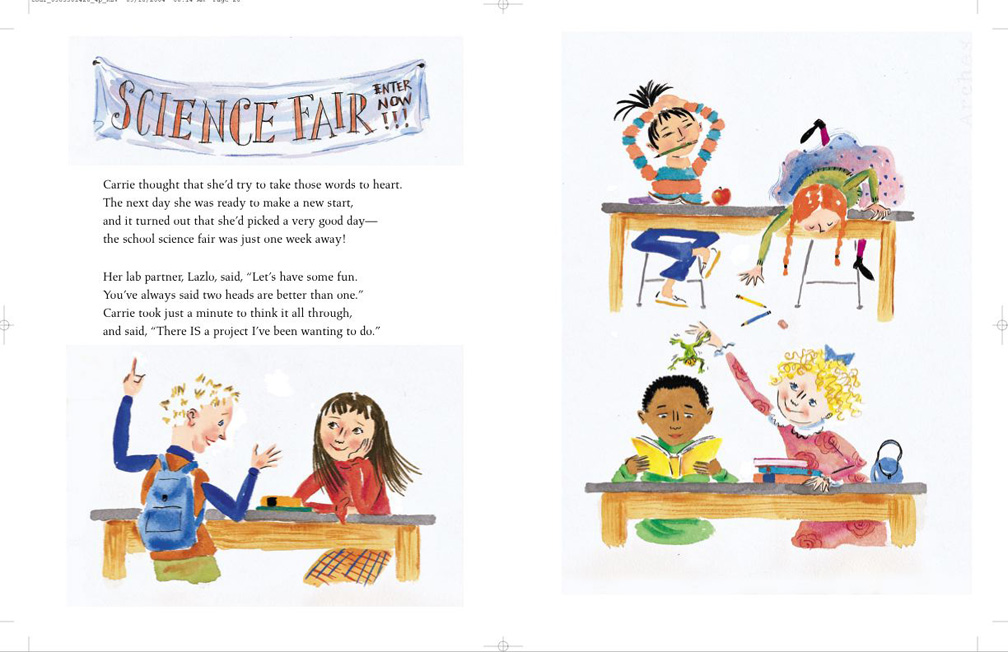
            I chose this book because it was written by Katie Couric, and I thought it might be an interesting to read. This book is about a young girl Carrie who tries out for soccer with her friend but doesn’t do well. She gets discouraged when she doesn’t make the team, but her mom tells her that everyone is good at something they just have to find what it is. Later that week Carrie enters a science fair with her friend Lazlo, and they win first place! She then goes and watches her friend at the soccer game, and her friend wins too. 


            The illustrations in this book have a child-like quality and looked to be mainly watercolor. The lines of the people are simplistic and cartoon in form. On some pages a panel effect is used to depict the sequence of events in the story. There is a considerable amount of negative space with colorful illustrations on the pages. This creates a bright and optimistic tone to the book. The cover of the book has a single panel design with the author’s picture and description on the back. 


            This book had an excellent flow of rhythm and rhyme scheme. Because of this, it would be a great book to introduce with narrative poems. It would also be an excellent choice to read for character education when explaining that everyone has strengths and not everyone’s strengths are the same. This book would be most appropriate for students in grades 3rd and up. One great project to do with this book would be to have students write about something at which they excel. Teachers may use a prompt stating, “How can you relate to Carrie? Carrie’s strength was science instead of soccer. If the story was about you, what would your strength be?” Another method a teacher could use might be to have students create a Venn diagram depicting similarities and differences they have with Carrie. This would also be a good book to use for in integrated language arts lesson when introducing solvents and solutions. 

Click on Katie Couric's name to go to the link of The Blue Ribbon Day website.

Blog #11 Micawber


Micawber

Written by John Lithgow
Illustrated by C. F. Payne
Simon & Schuster
2002
35 pages
Poetry

            I chose this book because I was immediately captured and intrigued by the squirrel on the cover holding a painter’s pallet and his tail like a brush. In this story, a squirrel that lives in Central Park goes to an art museum every day. One day as the squirrel is admiring the paintings, he looks down to see an artist painting a picture. He is so intrigued that he climbs down after she is finished and sneaks into her bag. Later that night while the woman is sleeping Micawber creeps out of the painter’s bag and explores its contents. He discovers the pleasure of painting and returns each night to paint a picture. 


            This book is such a work of art! The illustrations are in mixed media and immerse the reader in the world from the squirrel Micawber’s perspective. The bright coloring of the book gives the reader a sense of Micawber’s fast paced and free life. The illustrations are formatted in an informal style with the text on the same page as the pictures but still in stanza-ed lines. The cover is a single image with an illustration of the main character on the front and a picture and description of the author on the back. The illustrious detail of each page reflects the main character's love of art and how beautiful it can be. For example, in the picture below Micawber's tail is so detailed it seems as though one could reach out and feel how fluffy it is. 


            This book was such an enjoyable read. It would be most appropriate for upper level elementary students due to the high level of vocabulary used throughout the book. An excellent way to use this in the classroom may be as an art study project. Students could choose from one of the artists mentioned in the book and do a presentation on a painting of that artist’s that Micawber might have seen in the book. Another way to use this book would be as a robust vocabulary builder. It could also be used in several different types of word sort lesson including compound words or vibrant verbs. This book could even be used as high up as middle school due to the vocabulary and the text to text connections that students could make between Micawber the squirrel and Wilkins Micawber from David Copperfield. This book was a New York Times Best-Seller.

Below is a video of how the author John Lithgow feels about reading aloud to children.