Thursday, October 25, 2012

Blog #15 Somewhere in the Ocean


Somewhere in the Ocean

Written by Jennifer Ward and T.J. Marsh
Illustrated by Kenneth J. Spengler
Rising Moon
2000

Fantasy

          I chose this book because the cover art was so vibrant and eye-catching. In this book, the reader travels through the ocean to see the abundance of the varied animal life living in the ocean. The book depicts the animals in number groups starting from one and going through ten. Each animal group consists of a parent and his/her offspring. The parent tells the baby animal/animals to do an action that is related to that animal, and the baby/babies reply with an action sentence. For example, the mother octopus says, “Squirt!” and the baby octopi say, “We squirt!”
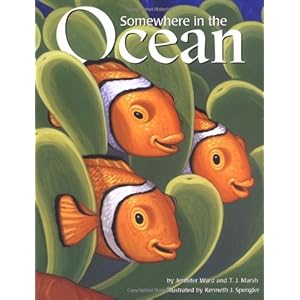


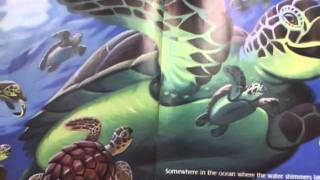
          The illustrations in this book are gouache on watercolor paper. Every scene of the book is a double paged spread depicting the certain animal being described in its habitat in the ocean. The medium used allows for dense vibrant colors that almost swim off the page toward the reader. The use of color and exacting detail provide a visual experience for readers and listeners alike. The swirling brush strokes of the background reflect the rolling motion of the sea and draw the eye across the page with the images of the various animals. 


          This is an excellent book for younger elementary students, primarily kindergarten and first graders. However, teachers could use this book in second grade and have the students use the reference guide in the back of the book as a starting point for class presentations on different animals found in the ocean. In kindergarten particularly this would be an excellent integrated language arts lesson involving math. In first grade, the students could be given sentence stems for eleven and have to write a sentence about an animal in the ocean that correlates with that number. This book has an abundance of activities that could be used with it. It would definitely be an asset in the classroom!


Below is a video that can be used in the classroom to increase fluency using this book as a basis. The teacher would need to track the words as the students sing along. 

Blog #14 Somewhere in the Ocean


The Ballad of Valentine

Written by Alison Jackson
Illustrated by Tricia Tusa
Dutton Children’s Books
2002
29 pages

Poetry

                I chose this book because not only was the cover captivating, but I knew it would be a good poetry book to use considering it has “ballad” in the title. This book is about a man who tries and tries to get a letter to his love interest Valentine. He tries everything from a homing pigeon to a bonfire, but every attempt is somehow ruined. Unsuccessful try after unsuccessful try leave the man feeling hopeless at the end of the book, but then there is a happy ending. I don’t want to spoil it for you so you’ll have to read it!


                The illustrations in this book look to have been made using watercolor and pen. The edges of the characters and objects are clearly defined with black outlines making the pictures crisp and easy to distinguish. The double-paged spread illustrations tell as much of the story as the words do in this book. They are so detailed and easy to understand that one could read the story purely through the pictures. The horizontal lines move in an up and down pattern across the page. The rolling mountains across every page represent the up and down feelings of the suitor trying to get Valentine’s attention then being unsuccessful. The colors are natural but saturated which again could reflect the suitor’s feelings toward Valentine.


                This is an excellent book to introduce for a poetry lesson around Valentine’s Day. This book could be used for practically any elementary aged group, but I would suggest using it with fourth grade and down. A fun activity that the teacher could have students do would be for them to write a rhyming stanza of the poem depicting another way the suitor could have tried to get Valentine’s attention. There are also many word sorts that could be drawn from this book; for instance, compound words are prevalent throughout the book.

To visit Alison Jackson's website, click on her name.   

Wednesday, October 24, 2012

Blog #13 My Favorite Bear


My Favorite Bear

Written and Illustrated by Andrea Gabriel
Charlesbridge
2004
27 pages

Poetry

       I chose this book because of the detailed close-up illustration of the bear on the cover. This story is about a mother bear telling her baby cub about the other bears in the world. She tells him about several kinds of bears, what different bears like to eat, and what they look like. She finishes the story by telling the baby bear that while there are many bears in the world he is her favorite. 


       The illustrations in this book look to be either oil pastels or crayons. The hash marks created by the different strokes of the crayons give a sense of depth and dimension to the illustrations. Each page is a full illustration with one line of the book on each page or every other page. The main focus of the book is the illustration of the various types of bears. At the end of the book there is a cataloged index of each type of bear depicted in the book with a picture and description of that type of bear. The double-paged spread of most of the illustrations allow for considerable detail to be put into the bears’ features. Although the style of art is not abstract or surreal, it is not overly-realistic to where the reader cannot tell whether they are looking at a painting or a picture.  


       This book is most appropriate for lower elementary grades, mainly kindergarten or first grade. The most evident use of this book would be as an introduction into the different types of bears and how they interact with their environment. An interactive method teachers may use with this book might be to have students draw a picture of a type of bear and write a sentence about that type of bear. For older grades, teachers could have students use this book as a model and have them write their own book about different types of a species of an animal. The book would include at least three types of the species with a cataloged index in the back of the book. Teachers could also have older students do a group project on the different types of bears that would include their habitat, diet, and appearance.

This book was named on the Bank Street College of Education's Best Children's Books of the Year.

To view more illustrations and artwork by Andrea Gabriel, click her name .